ALLIED BOARD KONSULT
Foreign Investment in Ghana
How to Structure Your Business to Attract Foreign Investment in Ghana
12/20/20252 min read
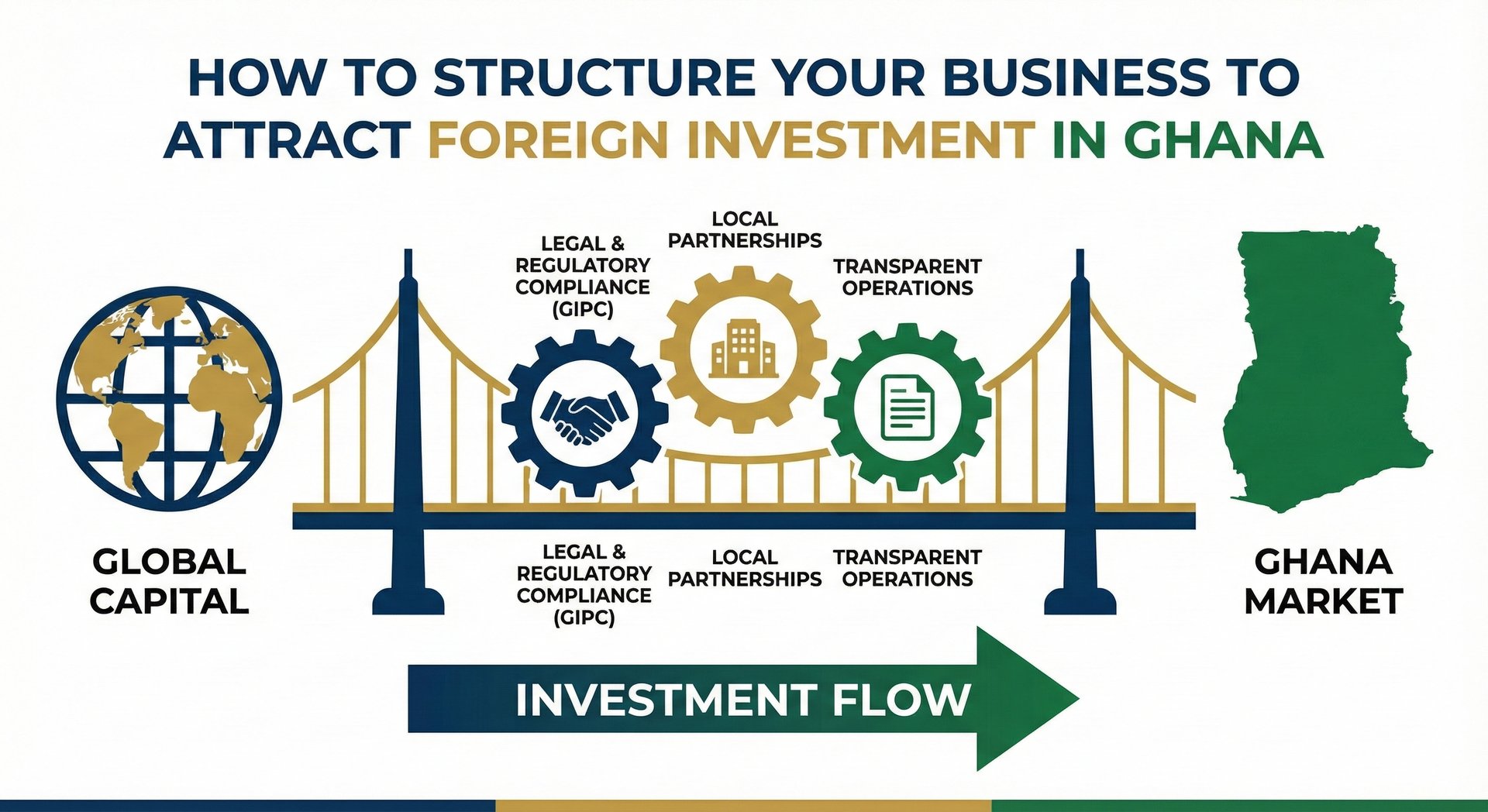
Ghana remains one of the most attractive destinations for Foreign Direct Investment (FDI) in West Africa. However, international investors—whether they are venture capitalists from London or infrastructure funds from Dubai—look for more than just a good business idea. They look for institutional readiness.
If your business is not structured correctly from a legal and financial perspective, you will likely fail the due diligence phase. At Allied Board Konsult, we help local firms "dress up" for investment. Here is how to structure your business to attract global capital in 2025.
1. Choose the Right Legal Entity
Most foreign investors prefer to invest in a Company Limited by Shares. This structure provides clear boundaries between personal assets and business liabilities. If you are currently operating as a sole proprietorship, your first step is to incorporate or convert into a limited liability company through the Office of the Registrar of Companies (ORC).
2. GIPC Registration and Minimum Capital Requirements
If you are seeking a foreign partner, you must comply with the Ghana Investment Promotion Centre (GIPC) Act, 2013 (Act 865).
For a joint venture between a Ghanaian and a foreign partner, the foreign investor must invest a minimum of US$200,000 in equity.
For a 100% foreign-owned business, the minimum capital requirement is US$500,000. Ensuring these figures are accurately reflected in your capital structure is vital for a smooth GIPC registration, which unlocks benefits like tax holidays and quota for expatriate workers.
3. Clean Audits: The Investor's "Green Flag"
An investor will rarely put money into a business with "unaudited" accounts. Clean, ICAG-standard audits for the last 2–3 years prove that your business is transparent and that your revenue figures are real.
Tip: Avoid mixing personal MoMo transactions with business revenue. Investors see this as a "Red Flag" for poor corporate governance.
4. Robust Corporate Governance
Investors look at your Board of Directors. Do you have a Company Secretary? Are there board minutes for major decisions? A well-structured board shows that the business is not a "one-man show" and can survive and grow even if the founder is not present.
5. Tax Compliance and Incentives
No investor wants to inherit a massive tax debt. Ensure your Tax Clearance Certificates are current. Furthermore, structuring your business to take advantage of specific incentives—such as those in the Free Zones or for "One District, One Factory" (1D1F) projects—can make your business significantly more attractive by increasing the projected Return on Investment (ROI).
Ready to Go Global?
At Allied Board Konsult, we provide the Audit, Tax, and Secretarial support needed to make your business "investment-ready." Don't wait until you find an investor to fix your structure—fix it now so you are ready when the opportunity strikes.
Contact us today for a Due Diligence Readiness Assessment
Contact
info@alliedboardkonsult.org
+233 24 9950176
© 2026. All rights reserved.